
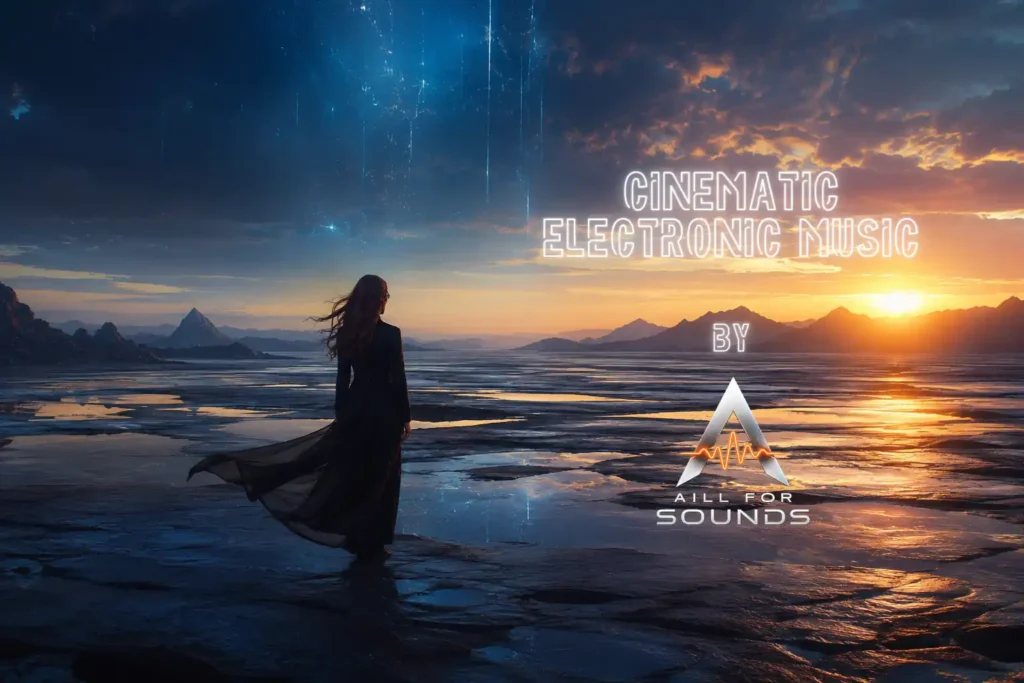
Cinematic Electronic Music: Where Sound, Emotion and Atmosphere Meet
Electronic music does not always have to be built only around the dance floor. Sometimes a track can feel like a scene from a film, a distant landscape, a memory or a journey through a place that does not completely exist.
This is where cinematic electronic music begins.
It combines electronic production with atmosphere, emotion and storytelling. Instead of focusing exclusively on rhythm, cinematic electronic music creates a wider sonic environment around the listener.
Deep bass, evolving textures, organic percussion, expressive melodies, guitars, strings, traditional instruments and subtle ambient layers can all become part of the same musical world.
For AillForSounds, this approach is an important part of creating electronic music that feels immersive rather than purely functional.
What Is Cinematic Electronic Music?
Cinematic electronic music is less about following one strict genre formula and more about creating a particular experience.
The word cinematic describes music that can suggest images, movement and emotion even when there is no film attached to it.
A composition may evoke an empty desert road, a distant mountain landscape, a city after midnight, an open coastline or a quiet moment just before sunrise.
Electronic production makes it possible to build these environments from many different layers.
A track can combine:
- deep electronic bass
- atmospheric synthesizers
- organic percussion
- acoustic instruments
- cinematic strings
- guitar textures
- vocal elements
- ambient sound design
- gradual musical tension
- spacious reverberation
The result can sit somewhere between electronic music, deep house, organic house, soundtrack music and experimental production.
The borders are intentionally flexible.
Music That Creates Images
One of the most interesting qualities of cinematic electronic music is its ability to create visual associations.
A listener may hear a melody and immediately imagine a landscape.
A bass line can create a sense of movement.
A distant vocal can make a track feel mysterious.
A single guitar phrase can completely change the emotional character of an electronic arrangement.
This relationship between sound and imagination is one of the foundations of cinematic music.
The composition becomes more than a sequence of beats.
It becomes a place.
The Role of Atmosphere
Atmosphere is often what separates cinematic electronic music from more conventional electronic production.
There may still be a strong rhythm and a clear groove, but additional layers create depth around them.
Reverb can make an instrument feel distant.
A soft texture can create the impression of air or space.
A slowly evolving synthesizer can introduce tension without becoming the main melody.
Small details can remain almost unnoticed while still changing the emotional perception of the entire track.
This is why cinematic production often rewards repeated listening.
The rhythm may be immediately recognizable, while the background continues to reveal new elements.
Cinematic Electronic Music and Deep House
Deep house provides an especially interesting foundation for cinematic production.
Its steady rhythm leaves space for additional musical elements.
A deep bass line can maintain the groove while melodies, organic instruments and atmospheric textures develop above it.
This creates a balance between movement and immersion.
The music can remain accessible while still carrying a strong emotional character.
For AillForSounds, this space between deep electronic rhythm and cinematic atmosphere creates an opportunity to move between different musical influences without being limited by a single traditional genre.
Some compositions can feel warm and organic.
Others can become darker and more dramatic.
Some may be inspired by open landscapes, while others feel closer to late night urban environments.
The electronic foundation connects them.
Organic Instruments Inside Electronic Production
Cinematic electronic music becomes especially expressive when electronic and acoustic elements interact.
A synthesizer can create an atmosphere that would be difficult to reproduce acoustically.
At the same time, a live sounding instrument introduces imperfections and details that make a composition feel more human.
This combination can include instruments such as:
- violin
- acoustic or electric guitar
- slide guitar
- piano
- hand percussion
- oud
- santur
- resonator guitar
- traditional drums
They do not necessarily have to dominate the arrangement.
Sometimes only a short melodic phrase is enough to create the identity of an entire track.
An acoustic instrument placed inside a modern electronic production can also create contrast.
The old meets the new.
Organic textures meet electronic precision.
Traditional sounds meet contemporary production.
That contrast can become part of the story.
Music Inspired by Places and Cultures
Electronic music can absorb influences from almost anywhere.
Rhythms, instruments and melodic ideas associated with different regions can be transformed inside a modern production without turning the composition into traditional music.
This opens an enormous creative space.
A track may carry the warmth of a desert atmosphere.
Another may suggest wide steppe landscapes.
Another can use melodic elements associated with Persian, Mediterranean, Balkan or Nordic musical traditions.
The purpose does not have to be to recreate a specific style.
Instead, these influences can become colors inside a larger electronic composition.
This approach is particularly suited to cinematic music because cinematic sound is naturally connected with imagination and place.
Emotion Before Genre
Genre labels are useful for discovering music, but they do not always describe the entire experience.
A single electronic composition may contain elements of deep house, organic house, blues, ambient music and cinematic soundtrack production.
Trying to place every element inside one category can become restrictive.
What should the listener feel?
Melancholy. Freedom. Tension. Movement. Calm. Distance. Energy. Mystery.
These emotional directions can influence everything from tempo and instrumentation to sound design and arrangement.
The genre becomes the foundation. Emotion becomes the destination.
Building a Cinematic Electronic Track
A cinematic composition often begins with a simple musical idea.
It may be a melody, a rhythm, a bass pattern or even a particular atmosphere.
From there, additional layers can gradually expand the musical environment.
A minimal introduction can create anticipation.
Percussion introduces movement.
Bass provides weight.
A melodic instrument introduces identity.
Background textures create space.
The arrangement can then grow toward a larger emotional moment before returning to something more restrained.
The most important element is not necessarily complexity.
It is direction.
Every part of the production should contribute to the world the track is trying to create.
Why Space Matters
Silence and space are powerful elements in cinematic electronic music.
When every part of the frequency spectrum is constantly occupied, a composition can lose depth.
Allowing certain sounds to breathe makes individual elements more significant.
A guitar phrase feels larger when it appears after a moment of restraint.
A bass drop becomes more powerful when the arrangement creates anticipation before it.
A distant vocal becomes more mysterious when it is not surrounded by too many competing elements.
Cinematic production often depends as much on what is removed as on what is added.
The AillForSounds Approach
AillForSounds explores electronic music through different atmospheres, instruments and cultural inspirations.
Rather than keeping every release inside exactly the same sonic template, the catalog moves between deep electronic grooves, cinematic environments, organic textures and more experimental combinations.
Some tracks are driven primarily by rhythm.
Others place more emphasis on melody or atmosphere.
Traditional sounding instruments can appear next to modern bass production.
Blues influenced guitar can meet electronic percussion.
Strings can exist inside deep house arrangements.
Different musical worlds can overlap while remaining connected through an electronic foundation.
This evolving approach makes each release part of a larger musical exploration.
Cinematic Music Without a Film
One of the freedoms of cinematic electronic music is that it does not need an existing visual story.
The listener creates the visual world.
Two people can hear exactly the same composition and imagine completely different scenes.
For one person, a track may suggest driving through an empty landscape at night.
For another, it may feel like standing above a city just before sunrise.
That ambiguity is part of the experience.
Music provides the atmosphere.
The listener creates the film.
Discover More Cinematic Electronic Music
Cinematic electronic music exists somewhere between rhythm and imagination.
It can be energetic without losing atmosphere.
It can be emotional without becoming overly dramatic.
It can combine electronic production with acoustic instruments, traditional influences and modern sound design.
Most importantly, it allows music to become something larger than a genre label.
It can become a landscape, a memory or a story without words.
AillForSounds continues to explore that space through an expanding catalog of electronic releases built around rhythm, atmosphere and musical experimentation.
Explore AillForSounds
Discover the complete music catalog
Explore AillForSounds releases shaped by cinematic atmosphere, deep electronic rhythm, organic instruments and different musical influences.
Explore Music